
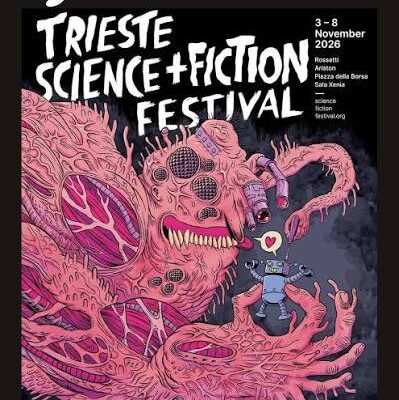
THE WINNERS OF THE 26TH EDITION OF
TRIESTE SCIENCE+FICTION FESTIVAL
OVER 20,000 ATTENDEES
AT THE TRIESTE FESTIVAL
The 26th edition of Trieste Science+Fiction Festival, Italy’s leading event dedicated to science fiction, concluded with the awards ceremony at the Politeama Rossetti on Sunday 8 November.
Organised by La Cappella Underground, the centre for cinematic and audiovisual research and experimentation, the festival once again brought the finest productions in fantastic cinema to the big screen in 2026, with over 60 world, international and national film premieres and three competitions attended by directors, actors and filmmakers from around the world. The 2026 edition welcomed over 20,000 attendees to its screenings and scheduled events, confirming the success of the Italian festival, which brings the best of international science fiction cinema to the big screen every year.
“We are thrilled by the significant increase in attendance at this year’s Trieste Science+Fiction Festival and by the fact that everyone is telling us this edition’s programme was the best ever,” said Festival Director Alan Jones. “Science fiction is a space for experimentation where we can reinvent our world, and knowing that so many more people shared this journey with us in 2026 is a wonderful feeling. Technology changes, and so do the questions we keep asking ourselves. But the most fascinating and profound questions remain the same: how we live, what we create and what future we want to build as the world races ever faster ahead. These are the questions Trieste Science+Fiction Festival will continue to ask, seeking answers through the universal language of our beloved science fiction and fantasy, in all their forms and variations.”
THE WINNERS OF TRIESTE SCIENCE+FICTION FESTIVAL 2026
ASTEROIDE AWARD
The Asteroide Award honours the best science fiction, horror or fantasy film among the emerging directors, presented in the festival’s Neon section. The award was presented by an international jury comprising Paolo Strippoli, Emma Braslavsky and Morten Haagensen.
Winner of the Asteroide Award TS+FF 2026
“Species (Sanguine)” by Marion Le Corroller (France, Belgium / 2026)
Jury Statement
We honour a film that turns body horror into a biting diagnosis of our times. It tells the story of a generation whose dreams are shattered by precarious working conditions and a society that leaves little room for the future. What truly frightens us is neither blood nor violence, but the disturbing reality behind them. Raw, furious and unexpectedly poetic, this film gives horror a voice of its own and a sense of urgency we could not ignore.
Synopsis
Margot dreams of becoming a doctor who can save lives. But as an intern in the country’s most competitive emergency department, she struggles to keep up. Soon, stressed and weakened young patients come to her with unusual symptoms, just as she begins to undergo a strange metamorphosis…
MÉLIÈS D’ARGENT AWARD – FEATURE FILMS
The competition is organised in collaboration with the Méliès International Festivals Federation (MIFF) and is open to European-produced feature films in the fantastic genre. The 2026 Méliès d’argent jury comprises Valentina Ariete, David Cox and Martin Unsworth.
Winner of the Méliès d’argent Award – Feature Films TS+FF 2026
“The Squirrel” by Markus Lehmusruusu (Finland, Germany, Netherlands, Sweden / 2026)
Jury Statement
For this year’s award, we chose a film that struck us as truly unique: full of humour, tenderness and imagination. It creates a clearly defined future world in a simple and subtle way, and also has the best ending of any film at the festival.
Synopsis
In a future where nature has been wiped out by technology, life is clean, safe and comfortable. Pasi, a designer of synthetic animals, is quite happy with this until he comes across the world’s last living squirrel and takes it home: a serious breach of hygiene regulations, prompting inspector Emilia to investigate. Keeping a wild animal alive proves far harder than designing one. The squirrel becomes depressed, Pasi falls in love with Emilia, and his carefully planned life falls apart.
MÉLIÈS D’ARGENT AWARD – SHORT FILMS
The competition is organised in collaboration with the Méliès International Festivals Federation (MIFF) and is open to European-produced short films in the fantastic genre. The award goes to the short film receiving the most audience votes.
Winner of the Méliès d’argent Award – Short Films TS+FF 2026
“Rolling Mother” by Alexander Peskador (Germany, 2026)
Synopsis
When Wilhelm decides to sell the house of his late mother Hildegard, she unexpectedly returns from the dead… in the form of a murderous tin can.
AUDIENCE AWARD – NEON SECTION
Open to fiction feature films presented in the Neon section, this award goes to the film receiving the most votes from audiences at the screenings.
Winner of the Audience Award TS+FF 2026
“5 More Minutes” by Javier Ruiz Caldera (Spain, 2026)
RAI 4 AWARD
Rai 4, media partner of Trieste Science+Fiction Festival 2026, presents the award for the best film of the 26th edition.
Joint winners of the Rai 4 Award – TS+FF 2026
“The Alice paradox” by William Brooke (United Kingdom, 2026)
“5 More Minutes” by Javier Ruiz Caldera (Spain, 2026)
Jury Statement – “The Alice Paradox”
For its ability to rigorously translate the boldest interpretations of quantum physics – a universe made up of many possible worlds, all real – and use them to question the epistemological foundations of science… for portraying the dialectic between our individualistic, market-driven world and a divergent reality in which knowledge is a collective endeavour… for exploring the role and choices of a female scientist through a noir of unsettling images, centred on the protagonist’s encounter with her own Double.
Synopsis – “The Alice Paradox”
While explaining a famous thought experiment in quantum mechanics, Alice travels back in time and is transported to an alternative version of her recent past, where she meets different versions of herself, her friends and her laboratory partner Bob. Trapped in a world that diverged from ours during the Cold War and prioritises the collective over the individual, Alice is forced to confront her life choices, questioning identity, destiny and the search for meaning.
Jury Statement – “5 More Minutes”
Year after year, film after film, the Apocalypse finds ever more bizarre ways to manifest itself: endlessly rewinding time… but only a handful of minutes at a time. How can we survive in a world where the most basic rule suddenly breaks down? What are we capable of when an emergency repeats itself obsessively? A divertissement that does not shy away from shocking images and situations… a masterclass in directing on the fatal gap between real time and cinematic time… a guide to breaking legs, and everything else… in just 5 minutes!
Synopsis – “5 More Minutes”
A couple on the verge of separating decide to spend a weekend in an isolated country house. There they meet the estate agent, who shows them around and hands over the keys. But before he leaves them alone, something extraordinary happens: the entire world enters a time loop and the last five minutes repeat endlessly, like a skipping record.
STARS’ WAR CRITICS’ AWARD
A critics’ award reserved for debut features and presented by Marco Lovisato, Beatrice Pagan and Simone Soranna.
Winner of the Stars’ War Critics’ Award TS+FF 2026
“Mum, I’m an Alien Pregnant” by THUNDERLIPS (New Zealand, 2026)
Jury Statement
The jury wished to honour a film that continues the proud tradition of New Zealand B-movies, following in the footsteps of illustrious predecessors such as Peter Jackson. The chosen film chews up and spits out – literally – the familiar “meet-cute” trope in a comedy as disgusting as it is unexpectedly romantic. It repeatedly made us cry “oh, mum!” in revulsion, but ultimately made us call our mothers to tell them we love them.
Synopsis
Mary and Boo are two reclusive twenty-somethings who live with their respective mothers, and both have a thing for tentacles – or rather, she is obsessed with tentacles, while he has tentacles instead of testicles. Mary’s dreams of moving out are put on hold when a jet of insemination results in an unwanted alien pregnancy. Both mothers interfere, but cannot navigate the bureaucratic delays surrounding abortion before alien nature takes its course and Mary goes into labour inside an igloo of vaginal mucus. Mary survives and heroically refuses to care for the alien baby, leaving that responsibility to the alien father.
SPECIAL MENTION – STARS WAR CRITICS’ AWARD
“Light Pillar” by Xu Zao (China, 2026)
Jury Statement
For conceiving and creating an animated film that overturns the relationship between manufactured images and reality; for using science fiction to address issues that are not only current but also anticipate their possible ramifications; and for doing so with a poetic sensibility that fights resignation rather than surrendering to it.
Synopsis
The future. Winter. Space travel is no longer a dream. A film studio, once thriving, is now on the brink of bankruptcy. The vast complex is completely covered in snow. Zha, a solitary caretaker, looks after this forgotten place with only a former feline actor for company. The studio owner, now penniless, pays him with a VR headset. Zha becomes captivated by the virtual world and begins a romantic relationship with another player. After a few dates, she invites him on a trip to the Moon…
CINELAB SPAZIO CORTO AWARD
Reserved for the best Italian short film presented in the Spazio Corto section, the award is presented by a jury of film-school students from across Europe attending Trieste Science+Fiction Festival 2026.
Winner of the CineLab Spazio Corto Award TS+FF 2026
“Edo2” by Andrea Scroccaro, Riccardo Torgano (Italy, 2026)
Jury Statement
As members of this year’s Academy, we decided to honour the short film that impressed and convinced us the most. Through the sensitivity with which it uses science fiction to comment on real life, and through its use of imagery and storytelling, it becomes an accurate portrayal of how technology can replace human beings.
Synopsis
As another summer draws to a close in a provincial town in Northern Italy, Edoardo struggles to regain control of a youth that feels far too restrictive.
EVENT HORIZON – INAF AWARD
This year, the award of the Italian National Institute for Astrophysics goes to “THE SQUIRREL” by Markus Lehmusruusu, for imagining, with gentle irony and visual precision, a dystopia born not of catastrophe but of a choice: a society that has entrusted technology with control over bodies, environments and emotions, erasing nature and, with it, the unexpected. In a white, sterile world devoid of animals, an encounter with a real squirrel awakens in the protagonist a curious, scientific gaze towards nature’s irreducible unpredictability, pushing him beyond flat, repetitive patterns. Science, like life, begins with wonder at what escapes our control: a world without surprises is also a world without discoveries. The film approaches with originality themes central to contemporary science: the loss of biodiversity, the evolutionary bond between humans and other living beings, and the limits of technological progress focused exclusively on safety and comfort. And it reminds us that surviving is not the same as living.

